
Key Highlights
- Social interaction develops communication, empathy, and cognitive skills
- Early exposure to peers enhances emotional resilience and cooperation
- Structured group activities foster problem-solving and confidence
- Comparative insights with top 10 pre-nursery schools
- Supports both child development and parental peace of mind
Table of Contents
- Introduction
- About Us
- Why Social Interaction is Critical in Early Childhood
- How Schools Facilitate Effective Social Engagement
- How does peer interaction boost communication skills?
- Why is collaborative play important for cognitive growth?
- How does social interaction enhance emotional intelligence?
- What role do teachers play in guiding social learning?
- Practical Benefits for Parents and Families
- Conclusion
- FAQs
Introduction:
The early years of a child’s life are foundational for developing communication, emotional intelligence, and social skills. At HEI School, the Best daycare in Gurgaon where while cognitive learning is vital, social interaction with peers plays an equally crucial role in shaping personality, confidence, and adaptability. For young children, the classroom and playground become the first arenas to explore collaboration, empathy, and problem-solving.
About Us:
At HEI Schools Sec 49, Gurugram, we emphasize social interaction as a key part of early development. Through group projects, storytelling, music, movement, and collaborative play, children learn communication, empathy, and teamwork. Our Finnish-inspired curriculum integrates social, emotional, and cognitive learning, allowing children to explore and share ideas confidently. By fostering friendships, cooperative problem-solving, and group engagement, HEI Schools ensures that children develop essential life skills while enjoying a joyful, supportive environment that nurtures both their personality and peer connections.
Why Social Interaction is Critical in Early Childhood
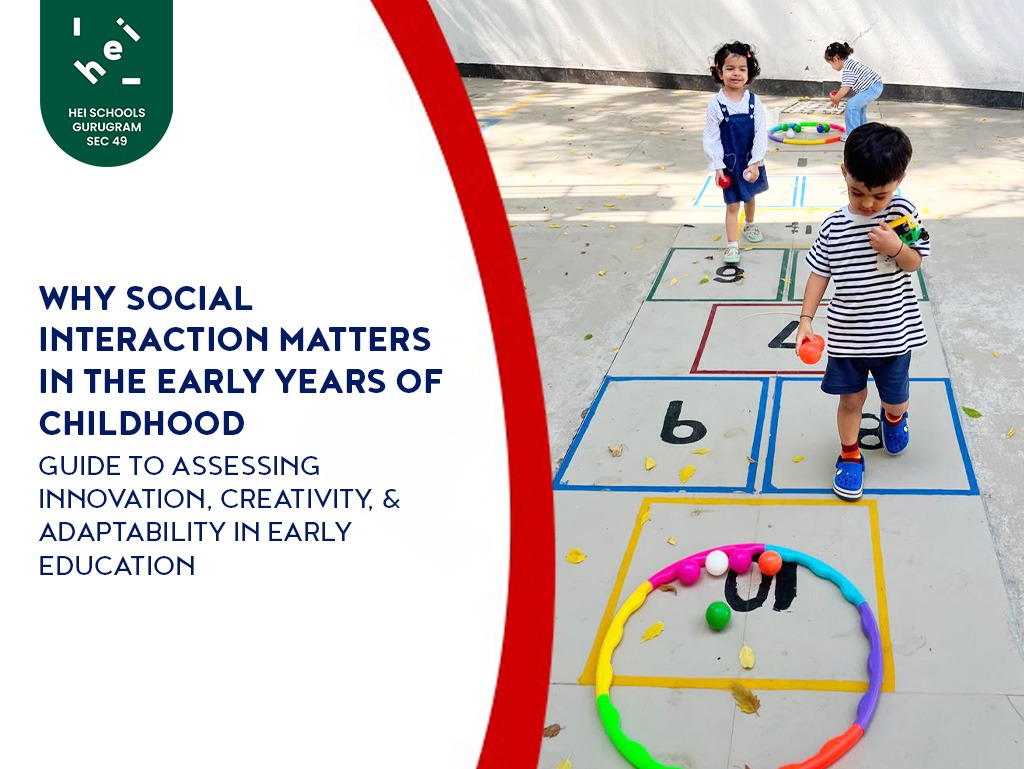
Social interaction in early childhood is more than just playtime—it is the foundation of communication, collaboration, and cognitive development. Children learn to express ideas, listen actively, and negotiate with peers, forming essential skills that last a lifetime.
Key benefits include:
- Communication: Developing vocabulary, articulation, and conversational skills
- Empathy: Understanding others’ feelings and perspectives
- Problem-solving: Learning to navigate conflicts and work collaboratively
- Confidence: Building self-esteem through participation and feedback
Without adequate social exposure, children may struggle with self-expression, cooperation, and adaptability in later years.
How Schools Facilitate Effective Social Engagement
How does peer interaction boost communication skills?
Peer interaction allows children to practice verbal and non-verbal communication. Through group storytelling, show-and-tell, and collaborative projects, children at HEI School learn to articulate thoughts clearly, listen attentively, and respond appropriately. Compared with some pre-nursery schools that focus heavily on individual tasks, HEI School ensures every child actively engages in group communication, enhancing vocabulary and expressive skills.
Why is collaborative play important for cognitive growth?
Collaborative play encourages problem-solving, critical thinking, and decision-making. Activities like building blocks, puzzles, and role-playing enable children to negotiate roles, share resources, and plan strategies. HEI School’s curriculum integrates structured play sessions that foster creativity and logical reasoning, unlike traditional setups where play may be unstructured or solitary.
How does social interaction enhance emotional intelligence?
Through interaction, children develop empathy, patience, and self-regulation. Conflict resolution, turn-taking, and cooperative games teach children to manage emotions and respect differences. HEI School provides guided social experiences that ensure children understand social norms, while peer learning accelerates emotional maturity relative to some independent pre-nursery programs.
What role do teachers play in guiding social learning?
Teachers act as facilitators, mediators, and role models for social behavior. At HEI School:
- Educators scaffold social interactions to maximize learning
- Staff monitor group dynamics to prevent exclusion or conflict
- Teachers provide feedback and reinforce positive social skills
- Compared with less structured pre-nursery schools, HEI School’s staff actively nurture healthy peer relationships
Chart: Core Benefits of Social Interaction in Early Years
| Benefit | Description | HEI School Approach |
| Communication | Speaking, listening, and understanding | Group discussions, storytelling, interactive sessions |
| Collaboration | Working together to solve problems | Team games, shared tasks, peer projects |
| Emotional Intelligence | Empathy, self-regulation, resilience | Guided conflict resolution, social-emotional activities |
| Cognitive Skills | Critical thinking, creativity | Problem-solving games, collaborative play-based learning |
| Confidence | Self-esteem, participation | Positive reinforcement, supportive environment |
Table: Comparing HEI School with Top 10 Pre-Nursery Schools in Gurgaon
| Parameter | Top 10 Pre-Nursery Schools | HEI School |
| Social Skill Focus | Moderate | Structured, teacher-guided, continuous |
| Peer Interaction Opportunities | Limited | Daily, integrated into curriculum |
| Teacher Facilitation | Informal | Professional, trained in social development |
| Play-Based Learning | Varies | Core to learning approach |
| Emotional Support | Partial | Integrated, consistent, individualized feedback |
Practical Benefits for Parents and Families
A socially engaging early years programme benefits parents as much as children:
- Reduced anxiety: Parents are confident that children are developing socially and emotionally
- Structured schedules: Consistent routines help working parents plan their days
- Professional guidance: Educators support behavior management and social readiness
- Holistic growth: Children gain academic, emotional, and social development simultaneously
- Peer support: Interaction with other families builds community and networking opportunities
Conclusion:
Social interaction in early childhood is foundational for cognitive, emotional, and social development. Structured programmes that encourage peer engagement, collaborative play, and guided learning create confident, empathetic, and resilient children. HEI School’s approach mirrors the best practices of top pre-nursery schools, providing a safe, nurturing, and socially rich environment that supports both children and working parents.
FAQs:
- How does HEI School encourage social interaction?
HEI School uses group activities, collaborative projects, and guided peer play. - Why is social interaction at HEI School important?
It builds communication skills, empathy, confidence, and emotional intelligence. - Do teachers guide social learning at HEI School?
Yes, educators scaffold interactions, mediate conflicts, and reinforce positive behaviors. - How does HEI School enhance collaborative learning?
Team games, problem-solving activities, and shared tasks foster cooperation. - Can social interaction benefit working parents at HEI School?
Yes, parents gain confidence knowing their child is learning social skills safely. - How does HEI School compare to other pre-nursery schools?
HEI School provides more structured and guided social learning than many peers.