

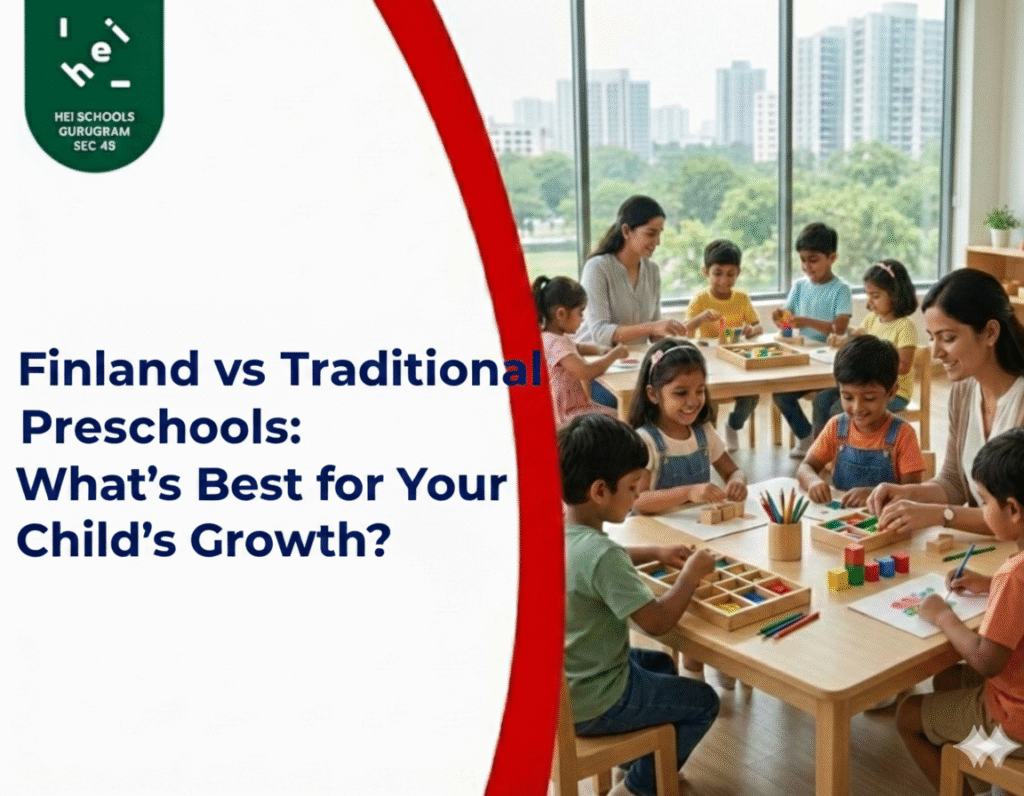
Introduction:
When choosing early education, many parents compare different teaching approaches to find what truly supports their child’s development. Today, the top preschools in gurgaon are increasingly inspired by the Finnish education model, known for its child-centric philosophy and balanced learning environment. But how does it differ from traditional preschool systems, and which approach is best for your child’s growth? At HEI School Gurugram, let’s explore the key differences and what they mean for early development.
About Us:
HEI Schools Gurugram Sector 49 offers a Finland-inspired curriculum that focuses on holistic development rather than rote learning. Children learn through play, creativity, collaboration, and experiential activities like art, music, movement, outdoor exploration, and project-based learning. Our modern classrooms, nurturing teachers, and personalized attention help build confidence and social skills. Regular events, celebrations, and interactive learning experiences ensure a balanced early education that supports overall growth and a lifelong love for learning.
Understanding the Traditional Preschool Approach
Traditional preschools in India have typically focused on early academics, structured routines, and classroom-based instruction. Children often follow a fixed timetable that includes writing practice, worksheets, and teacher-led activities.
While this method helps build discipline and early literacy or numeracy skills, it may sometimes place pressure on young learners. Limited flexibility and a strong academic focus can reduce opportunities for creativity, exploration, and independent thinking—skills that are equally important during early childhood.
What Makes the Finnish Approach Different?
The Finnish early education model is built on a simple belief: children learn best when they are happy, curious, and emotionally secure. Instead of academic pressure, the focus is on play-based learning, social development, and overall well-being.
Key features of the Finnish approach include:
- Learning through play and hands-on exploration
- Minimal emphasis on early formal academics
- Small group interactions and individual attention
- Outdoor learning and physical activity
- Focus on emotional, social, and creative development
This balanced approach helps children develop confidence, curiosity, and a love for learning from an early age.
Academic Readiness vs Learning Readiness
One major difference between the two systems is their definition of “readiness.”
Traditional preschools aim for academic readiness—recognizing letters, numbers, and writing early.
The Finnish model focuses on learning readiness—building attention span, problem-solving skills, emotional control, communication, and independence. Research shows that children who develop strong foundational skills through play and interaction often perform better academically in later years.
This shift from early performance to long-term development is why many parents are exploring globally inspired early learning environments.
Emotional Well-Being and Confidence
Young children thrive when they feel safe, valued, and stress-free. The Finnish approach prioritizes emotional security by maintaining a calm, supportive classroom environment with low teacher-student ratios.
Instead of comparison or competition, children are encouraged to progress at their own pace. This builds self-confidence, reduces anxiety, and helps them develop a positive attitude toward learning—an essential quality for future success.
Creativity, Curiosity, and Critical Thinking
Traditional methods often rely on repetition and structured outcomes, whereas Finnish-inspired learning encourages open-ended activities. Whether it’s building with blocks, storytelling, role-play, or outdoor exploration, children are free to imagine, experiment, and ask questions.
These experiences strengthen:
- Creativity and imagination
- Curiosity and exploration skills
- Critical thinking and problem-solving
- Communication and collaboration
The Pre Schools are now integrating such experiential learning practices to prepare children for a rapidly changing world.
The Role of Outdoor and Experiential Learning
Another defining feature of the Finnish model is the importance of outdoor learning. Regular interaction with nature improves physical health, focus, and emotional balance. It also enhances sensory development and observational skills.
In contrast, many traditional classrooms rely heavily on indoor instruction. Modern early learning centers are now redesigning their environments to include outdoor discovery areas, activity zones, and flexible learning spaces.
Conclusion:
Choosing between Finnish-inspired and traditional preschool methods is ultimately about what supports your child’s overall development. While early academics have their place, research and global practices highlight the importance of emotional security, curiosity, creativity, and confidence in the early years. By selecting a preschool that balances learning with well-being and exploration, parents can ensure their child grows into a happy learner ready to thrive in school and beyond.
FAQs:
Q1. What makes HEI School different from traditional preschools?
HEI School follows a Finnish-inspired model focused on play, well-being, and holistic development rather than early academic pressure.
Q2. Does HEI School teach academics?
Yes, but through experiential learning rather than rote methods.
Q3. How does HEI School support emotional well-being?
Small class sizes, calm environments, and child-paced learning help reduce stress.
Q4. Is the Finnish approach suitable for Indian children?
Yes. HEI School adapts global best practices to local learning needs.
Q5. How does HEI School prepare children for primary school?
By building attention span, communication skills, independence, and confidence.
Q6. Why are parents choosing Finnish-inspired education?
Because it focuses on long-term development rather than early academic pressure.
