

Introduction:
Early childhood education is evolving rapidly to prepare children for a world that values creativity, innovation, and problem-solving. At HEI School Gurugram, the preschool in gurgaon are now introducing STEAM learning—an integrated approach that combines Science, Technology, Engineering, Arts, and Mathematics—to help young learners explore concepts in a fun and meaningful way. At the preschool level, STEAM is not about complex theories; it’s about curiosity, exploration, and hands-on experiences that build strong foundations for future learning.
About Us:
At HEI Schools Gurugram Sector 49, STEAM learning is introduced through playful discovery and hands-on experiences. Children explore simple experiments, building activities, creative art projects, nature walks, and problem-solving games that spark curiosity. Our Finland-inspired approach integrates science, creativity, and critical thinking into everyday learning through theme-based projects and collaborative play. With engaging classrooms and experiential activities, we help young learners develop observation skills, imagination, and confidence.
What is STEAM in Early Childhood?
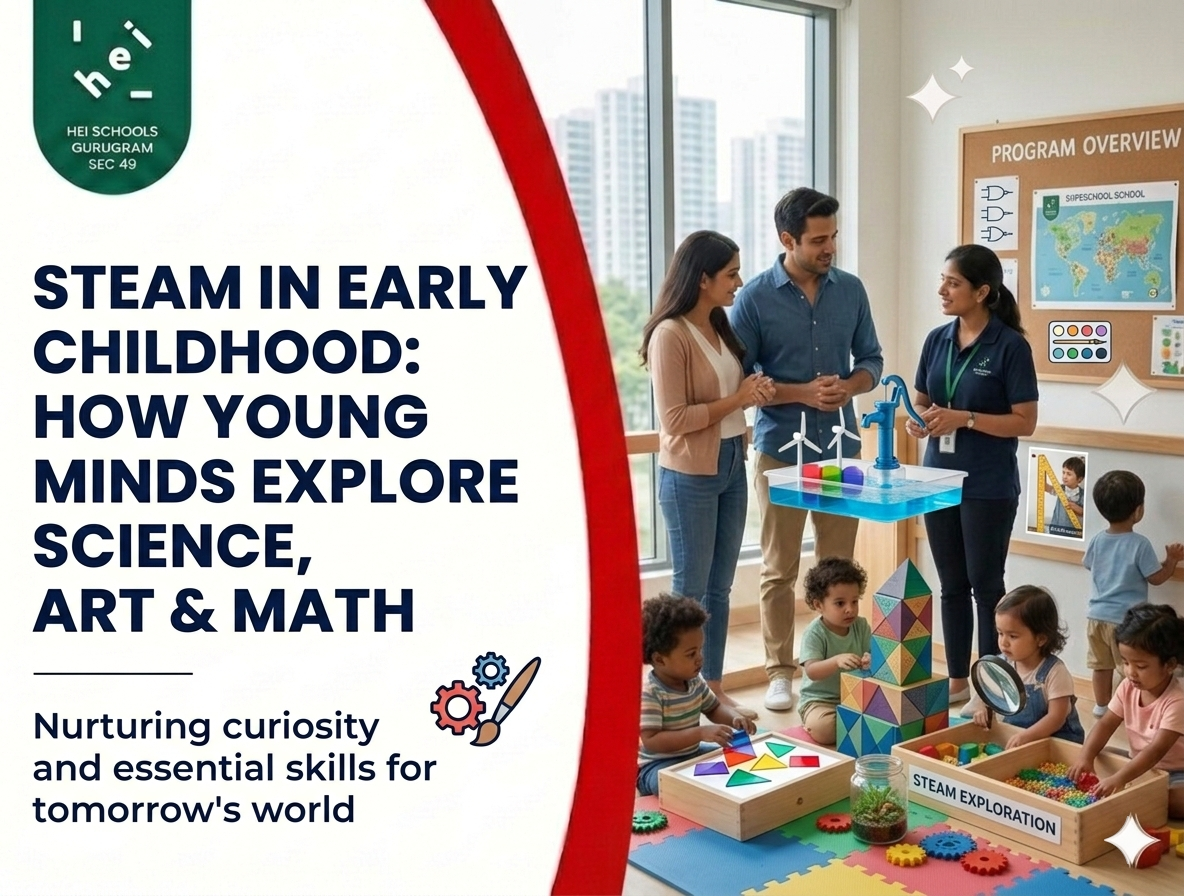
STEAM learning focuses on connecting different subjects through real-life activities and play. Instead of teaching science, math, or art separately, children experience them together through interactive projects and experiments.
For example:
- Mixing colors during painting introduces science concepts.
- Building with blocks develops early engineering and math skills.
- Exploring shadows outdoors teaches observation and scientific thinking.
- Counting objects during play strengthens numeracy.
This integrated approach helps children understand how ideas connect in the real world.
Encouraging Curiosity and Exploration
Young children are naturally curious. They ask questions, observe patterns, and experiment with their surroundings. STEAM learning supports this natural curiosity by creating opportunities for discovery.
Activities such as water play, nature walks, sensory experiments, and creative construction allow children to explore cause and effect. Instead of memorizing information, they learn by doing—developing critical thinking and problem-solving skills from an early age.
This hands-on learning builds confidence and encourages children to become active learners.
The Role of Art in STEAM
Art plays a crucial role in early STEAM education. Creative activities such as drawing, music, storytelling, and craft projects help children express their ideas and imagination.
Art enhances:
- Creativity and innovation
- Fine motor skills
- Emotional expression
- Visual and spatial understanding
When combined with science and math concepts, art makes learning enjoyable and meaningful. It also helps children see multiple ways to solve a problem.
Building Early Math and Logic Skills
Mathematics in early childhood is not about worksheets or memorization. Through STEAM-based activities, children naturally develop number sense, pattern recognition, and logical thinking.
Simple experiences like sorting objects, measuring ingredients, building towers, or identifying shapes help strengthen foundational math skills. These everyday interactions make learning numbers practical and engaging.
The Day Care Schools focus on such experiential methods to make early math stress-free and enjoyable.
Developing Problem-Solving and Innovation
Engineering concepts are introduced through play-based construction and design activities. Whether children are building bridges with blocks, creating simple structures, or solving puzzles, they learn how to plan, test, and improve their ideas.
These activities develop:
- Patience and persistence
- Trial-and-error learning
- Logical reasoning
- Teamwork and collaboration
Such skills are essential for future academic success and real-world problem-solving.
Learning Through Technology and Real-Life Experiences
Age-appropriate technology tools, interactive learning materials, and digital storytelling are also part of modern STEAM environments. However, the focus remains on balanced learning that combines screen-free exploration with guided technological exposure.
Outdoor learning, nature-based activities, and real-life observations further enhance scientific thinking and environmental awareness.
Holistic Development Through STEAM
STEAM learning supports multiple areas of development simultaneously:
- Cognitive growth through problem-solving and reasoning
- Language development through discussion and storytelling
- Physical development through hands-on activities
- Social skills through group projects and collaboration
- Creativity and confidence through open-ended exploration
This holistic approach prepares children not just for school, but for lifelong learning.
Conclusion:
STEAM in early childhood is about inspiring young minds to explore, question, and create. By combining science, art, math, and hands-on learning, children develop curiosity, confidence, and critical thinking skills that last a lifetime. Choosing a learning environment that embraces STEAM ensures that children grow into innovative thinkers, problem-solvers, and enthusiastic learners ready for the future.
FAQs:
Q1. How does HEI School introduce STEAM concepts?
Through hands-on activities like building, art, nature exploration, and simple experiments.
Q2. Is STEAM too advanced for preschoolers?
No. At HEI School, STEAM is introduced through play and everyday experiences.
Q3. How does STEAM improve problem-solving skills?
Children explore, test ideas, and learn through trial and discovery.
Q4. What role does art play in STEAM at HEI School?
Art encourages creativity, imagination, and innovative thinking.
Q5. Does STEAM help with early math skills?
Yes. Activities like sorting, counting, and measuring build number sense.
Q6. Why do parents prefer STEAM-based early education?
It prepares children for future learning and innovation-focused careers.
