
Introduction:
Early childhood education plays a pivotal role in shaping a child’s future. The first few years of learning are incredibly formative, providing children with the tools and skills they need to navigate the world. At HEI School, the Top PreSchool in Gurgaon, especially in urban hubs like Gurgaon, educators are increasingly adopting an approach that emphasizes both play and purpose. By designing meaningful learning experiences, these schools provide a strong foundation for children to thrive academically, socially, and emotionally.
About Us:
HEI Schools Gurugram seamlessly blends play with purpose, offering a curriculum that makes learning exciting and impactful. Every activity, from storytelling to collaborative games, is designed to spark imagination and promote cognitive development. Our aim is to create meaningful learning experiences that help children connect their play with real-world applications, building a strong sense of purpose and curiosity for the future.
Understanding the Play to Purpose Approach
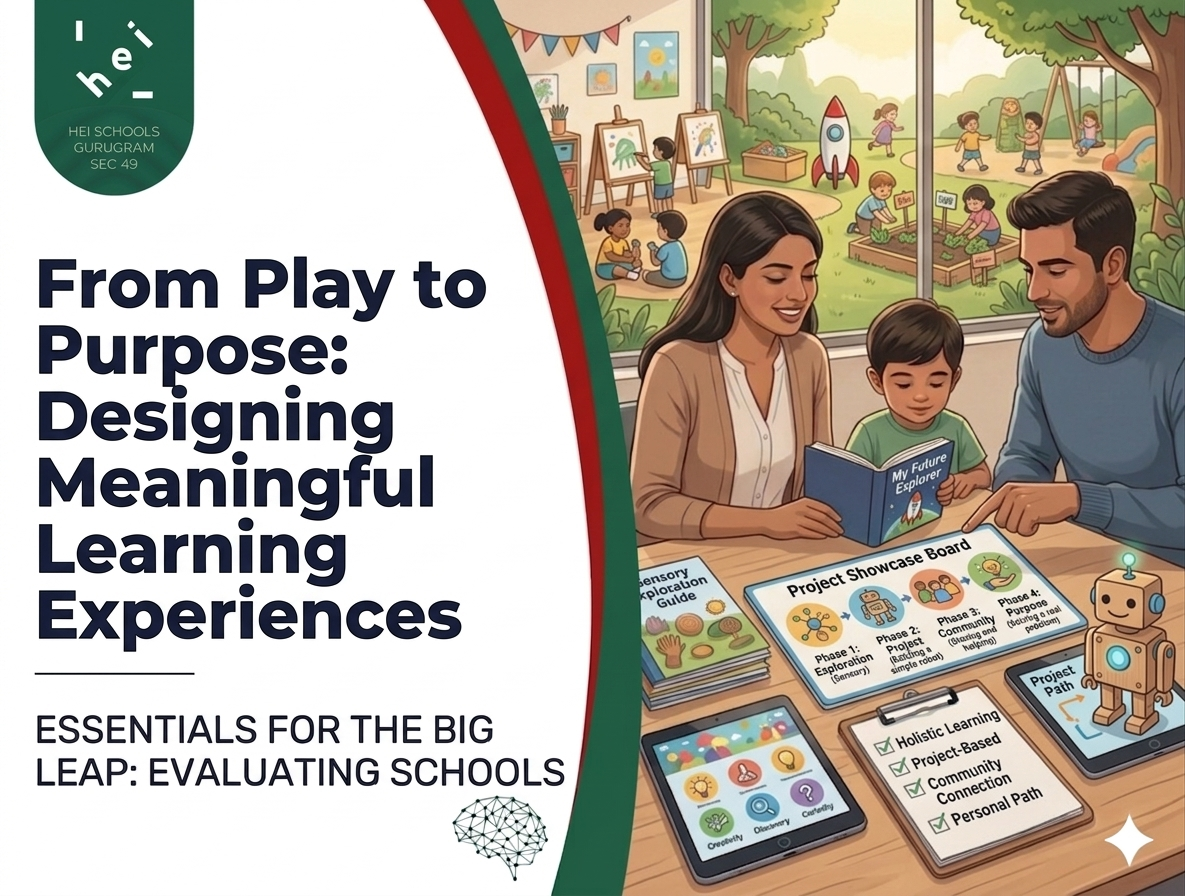
The “Play to Purpose” approach in early childhood education focuses on using play as a medium for achieving meaningful learning outcomes. In this approach, play is not seen as separate from learning, but rather as an essential vehicle for children to explore, interact, and develop new skills. It combines the natural joy of play with structured learning objectives, making the educational process engaging, enjoyable, and purpose-driven.
The Role of Educators in Designing Meaningful Learning Experiences
In good preschools, educators are the architects of these meaningful learning experiences. They use their knowledge of child development to design activities that are age-appropriate, challenging, and engaging. Teachers at these schools carefully plan each day, balancing time for free play with opportunities for structured learning activities that align with developmental goals.
Benefits of Play-Based Learning with Purpose
-
Fosters Cognitive Development:
Play-based learning encourages children to think critically, solve problems, and explore new ideas. Whether they are sorting shapes, building structures, or engaging in imaginative role-play, children develop important cognitive skills such as memory, attention, and problem-solving. These activities stimulate brain development and lay the groundwork for future learning. -
Promotes Social and Emotional Growth:
In play, children learn how to interact with others, express their emotions, and negotiate. Through collaborative play activities like group games, children practice essential social skills such as teamwork, communication, and conflict resolution. This helps them build healthy relationships with peers and develop empathy and understanding, key elements for emotional intelligence.
Creating a Balanced Environment for Play and Learning
For play to lead to purposeful learning, the environment must be carefully designed to facilitate exploration and discovery. In top preschools, classrooms are set up to encourage both independent and collaborative play. Learning corners are equipped with materials that inspire curiosity—such as books, building blocks, art supplies, and science kits—while outdoor spaces provide opportunities for physical play and nature-based learning.
Incorporating Real-Life Experiences into Play
Another aspect of designing meaningful learning experiences is the incorporation of real-life experiences into play. By connecting abstract concepts to the real world, children gain a deeper understanding of how what they are learning applies to their daily lives. For instance, during a cooking activity, children not only practice counting and measuring ingredients but also develop an understanding of the importance of nutrition and following directions.
The Role of Parental Involvement in Play to Purpose Learning
Parental involvement is a key element in reinforcing the play to purpose approach. Parents who engage in their child’s learning journey help bridge the gap between school and home. Whether through storytelling, arts and crafts, or educational games, parents can extend the lessons learned at school into the home environment.
Conclusion:
Designing meaningful learning experiences through a play-to-purpose approach is a powerful way to ensure that children develop the cognitive, social, emotional, and physical skills they need for success. As more parents seek out good preschools in urban centers, this approach is becoming the gold standard in early childhood education. By combining play with purpose, educators are laying the foundation for a generation of curious, confident, and capable learners.
FAQs:
- How does play lead to purposeful learning?
Play fosters creativity and problem-solving, making learning engaging and relevant to real-world experiences. - Can play-based learning improve academic performance?
Yes, children who learn through play develop strong foundational skills that benefit future academic achievements. - What makes meaningful learning experiences effective?
These experiences are interactive, engaging, and tailored to the child’s interests and developmental stage. - Why is play so important in early childhood education?
Play is the natural way children process information and explore the world, making it a critical component of learning. - How do preschools balance play and structured learning?
By incorporating play in structured lessons, preschools ensure that children remain engaged while meeting developmental goals. - Does HEI School follow a play-to-purpose approach?
Yes, HEI School designs meaningful, purposeful learning experiences that seamlessly integrate play and structured education.